by Jonathan Moremi
When the uprising in Soweto began, it came as no surprise to anyone. For months trouble had been brewing with pupils in Soweto boycotting schools in defiance of the oppressive Apartheid regime that wanted to force them to accept Afrikaans as a medium of learning. We, White boys and girls of privilege in a liberal-minded, politically aware private school in Parktown, Johannesburg, were appalled at this and rejected it as much as our fellow pupils in Soweto. To us, just like them, Afrikaans was the language of the oppressor, the language of those that refused to accept that all humans are equal and instead preached hate and discrimination in their churches of the (verkrampte) Nederduitse Gereformeerde Kerk (I never got what the Gereformeerd stood for). We, too, would not have wanted to be taught in Afrikaans. We learned it and wrote Matric in it, fair enough, after all it was one of the only two (sic) official languages of South Africa and thus not up for option. But we hated it for being the medium through which inhumanity and incitement against fellow South Africans was encouraged, something that seriously disgusted us.
Not all who spoke Afrikaans followed along those atrocious lines. Our Afrikaans teachers were wonderful, and my parents had Afrikaner friends in Pretoria who totally rejected Apartheid and were sharp critics of the regime (and still raged about it to me in Afrikaans twenty years after Apartheid had been dismantled). But overall, Afrikaans was spoken by those, who were fine with the oppression of the majority of people in South Africa, just because their skin colour was not ’worthy’ of human treatment. We truly hated them for that with the emotions and vigour that teenagers manage when they are genuinely enraged.
On the morning of 16 June 1976 the atmosphere in our school soon started to change from happy to grim. Our Black staff, loved and respected by us dearly and working on an island of equality and acceptance, lying in the midst of a sea of atrocities and danger, got phone calls from relatives in Soweto that things were not going well. News came that pupils had started to march and were met by police forces who opened fire on them. We were shocked. Shocked at hearing that children our age would be shot at by the police, and shocked to see the worries in the faces of our staff, who meant so much to us. Our favourite bus driver, Abdul, a tower of a man and strength, kindhearted and always smiling, who had accompanied us on all our class trips, sat with us at dinner at the campfires or played tennis with us in hide-outs, when we could be relatively sure that police would not discover us, was not his usual self anymore. The smile was gone and the confidence. And to our irritation he seemed not so much enraged about the ruthlessness of police shooting at children – but at the children for defying the police forces and ‘causing’ such a catastrophe.
To us teenagers, who so understood what those pupils our age in Soweto did, his reaction was disturbing. It took days for us to understand the reasoning behind this: That the Black adults had come to the conclusion, that a rogue regime like the Apartheid government with its firepower could not be fought, and subsequently any opposition of this kind would only lead to lives being lost. They had given in to horrible reality, while their children were not willing to accept the silence of their parents and started to march. It was the latter stance that we teenagers wholeheartedly supported, because it was totally in line with what we ourselves often felt in discussions with our parents. Adults lacked the courage to stand up to injustice and gave in to realities of which it was said that they “could not be changed”. The latter we rejected, fiercely believing that things could change, if one only stood up and fought for it.
Fear spread in our school
With more and more shocking news coming from Soweto, things in our school started to heat up. Scores of parents bombarded the principals office with phone calls, asking in panic if they should come and take their children out of school. They literally feared the whole country would now go up in flames. Some even offered to come to the school and escort the school buses heavily armed, to prevent kidnappings of the children to Soweto. The principal, my father, tried to calm them down. The unrest, he assured them, was currently restricted to Soweto and would not be a threat to our school in Parktown. He insisted that school would continue and that we pupils should stay where we are.
Then Abdul came to the principal’s office and told my father how scared the staff was to return to Soweto after school was over, and asked if the staff could stay the night at the school. The request was immediately granted. And when school ended, a huge effort was made to change the gym and the multipurpose hall into dormitories, to accommodate both sexes in what best comfort could be achieved with gym mats and blankets. In the end the staff stayed there for the next two nights, until they finally deemed it safe enough to take the trip back to Soweto and their loved ones, who they worried about deeply, as we could see. Their pain became ours. We did not agree with their adult approach to what happened, but to see our friends, as we considered them to be, to go through such horror, because of what the Apartheid regime had done, we found immensely disturbing. It was hard in those days to concentrate on our studies.
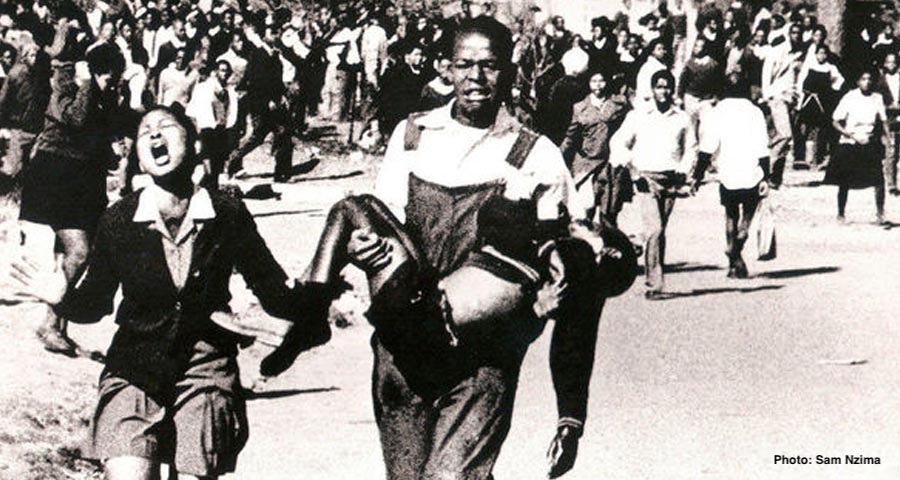
In the evening of 16 June 1976 the Johannesburg newspaper The Star, that was thrown into our front garden daily by the newspaper delivery man passing on motorbike, ran the photo of killed Hector Pieterson on the front page. What to that moment had been only a horror in our imagination now became reality in pictures. To see this young dead boy being carried away in the arms of another boy our age, who was crying his heart out, was another shock and convinced us even more, that defying the ruthless Apartheid regime had been a must and was not in any way negotiable. This was targeting more than just Hector or his companions, this was an attack on all of us in that age group who insisted on being friends not enemies.
One White death overshadowed everything
Then the reporting focussed on a White man who had been killed by enraged youths when passing them in their car and who was in the course of events stoned to death. It was, undoubtedly, a tragic affair, as the killed was a man who had been very much engaged all his time to help the youths in Soweto and alleviate their woes caused by Apartheid. That he of all people should be the White to be killed, seemed unfathomable to a White society that deemed itself entitled to decide who was worthy (and who was not) and had to therefore be untouchable. The Apartheid regime jumped at the opportunity and did not tire in pointing out, that the killing of this innocent man was the proof of the utter ruthlessness and lack of civilised behaviour on the part of the Black children, who needed to be disciplined in the brutal manner the government was accused of. The brutality, thus the argumentation, was born out of sheer necessity to protect innocent, well-meaning Whites from the savagery of evil Blacks. The government seriously had no other choice!
Ignoring the fact that the Apartheid regime Whites were anything but innocent and well-meaning, the propaganda bore fruit. When it was finally reported in the media that in the course of this catastrophe of 16 June 1976 not fewer than 176 Black children had been killed by the police (the estimates run even higher), it hardly caused a stir. What were 176 brutal, vicious, bloodthirsty Black children – compared to one well-meaning White? After all, he was married and left two children behind. Hearts were broken over this. The fact that 176 killed children left bereaved parents, siblings, grandparents, aunts, uncles and cousins behind, was not an issue. All of those were Blacks, so probably equally ruthless and rogue as those vicious children – who, lets honour truth, were peacefully marching down the streets of Soweto unarmed, when the police had opened fire. Unarmed. Peaceful. But who cares for details, when colour is of so much more importance and defines who is good and who is bad, who is allowed to live and who is to die.
The memories stay alive
The days and weeks that followed were filled with uneasy news of unrests flaring up here and there in the country and a government repeatedly insisting that the events of 16 June 1976 clearly showed, that only a fierce approach could save South Africa (aka the Whites) from total destruction. The pain of the families who lost their children was not up for discussion. And although it seemed to us that some of our Black staff, including Abdul, had started to change their opinion a little, not least as we repeatedly defended our fellow Black pupils and expressed our outrage over the brutality of the police against children (sic!), overall the bloody murder of so many our age was a shock that sat deep and once more emphasised to many Blacks, that it was just not feasible to fight back as it would only lead to even greater pain and terrible defeat. Steve Biko saw in this the loss of Black Consciousness and staunchly held against it. A year later the Apartheid regime killed him too.
When I think today of 16 June 1976, the events of those days are very much alive in my memory. I feel the shock over children my age killed (I was sixteen at the time), I remember the pain of our staff, the fear in their eyes, the panic of parents and the nervousness of the White population all over the Republic. And while of course visiting the Hector Pieterson memorial and the spot where he was shot dead is deeply emotional, when I think of that day, I think of those 176 children in and around my age group that were mowed down by the rifles of the Apartheid regime. And I feel as if I were hearing those children call out to us, to please not let them have died in vain.
South Africa is still not equal, and it is still not just. There is still so much to do. 176 small voices plead with us from their graves not to let go in the quest to make South Africa the country they so passionately dreamed of. It was a dream that cost them their lives. A dream that the living still have to ensure to finally come true.
.
.
.
Leave a Reply