by Jonathan Moremi
On one sunny Sunday morning in 1971 I arrived in South Africa from Europe at the age of eleven and was mesmerised by the beauty of this country. At first, we lived in a flat in Hillbrow, Johannesburg, while my parents looked for a house to rent, and at street level of this high-rise block of flats there was a little shop where you could buy snacks, cool drinks, newspapers and magazines. Although my parents did not approve of Disney comics as they found them to be intellectually not demanding enough, I nevertheless and being bored, seeing there was not much to do in a flat for the two months it took to find a home, convinced my parents to at least buy me in that shop the comic book Lady and the Tramp. It is a cute story of two dogs who fall in love, but have to fight hard against evil dog thieves and dog catchers. I loved it a lot, but there was one scene that totally devastated me, the eleven-year-old. It showed how stray dogs were taken from the streets by men with grim faces and large nets and thrown into a caged van to be transported to some faraway shelter. Seeing this, broke my heart. And to this day I feel the pain I felt looking at this scene, which to me showed never before experienced brutality against animals that I loved so much.
After finally leaving Hillbrow, moving to Fairlands and later Northcliff, it did not take long for me to realise that what I had seen in that comic book was an even grimmer reality on the streets of South Africa. Countless times in my youth and during teenage years I had to witness such scenes – only that now it was not dogs but Blacks, men and women alike, who were sjamboked by police men into caged vans like the stray dogs in the comic story of Disney. Witnessing this, shocked me, and I have not forgotten to this day the images that are burned in my brain and the feeling that in fact these human beings in front of me were treated with exactly the contempt and evilness as the stray dogs in what was otherwise a harmless children’s story. But this now was reality, the dogs were men and women, and there was nothing harmless any more about the story.
One image particularly is ingrained in my soul, that of a young Black woman who had been sjamboked into the already overcrowded van, now appearing at the barred window, and being shoved so hard against it, that the metal bars pressed into her cheeks. That in itself was unbearable to watch. But what shocked me even more as a white young boy was her look. There was nothing in it, no anger, no shock, no protest, no despair, just dead eyes enduring silently and without seeming to take interest in the humiliation and physical pain, because she knew she had no rights whatsoever. No right to protest, no right to resist, no chance to change the course of events. Her blank look of total resignation told me that she knew what was to happen because she had had to endure it multiple times before: Sjamboked into the van, driven to some police station, processed for hours without the right or financial means to a lawyer, not getting food, nor drink, in the end landing in some dirty cell, where she would have to spend the next two weeks before being thrown out into the streets. And then, continuing to try to live a human life – until the humiliation and pain of being treated like a stray dog would repeat, and repeat, and repeat. Her expression of having totally given up, being broken to the point of complete submission and passiveness, haunts me to this day. It was a horror relived a thousand times per day by innocent Black people whose only crime was to believe that being a human being in their own country should be the norm. It wasn’t, because the Apartheid regime of a White minority put hate and sjamboks over human rights.
It is against this backdrop of horror witnessed daily, not against political activists or so called ’terrorists’ but normal everyday people, that the death of Steve Biko in 1977 shook us to the bone. He was not just anybody. Although censorship tried its best to hide essentials from us, we knew who Biko was (not the least thanks to publications like Newsweek and TIME that luckily often enough managed to slip through the censor’s attention). And when news of his death made the rounds, we immediately rejected the blatant lies coming from the minister of the police, knowing full well that the Apartheid regime had killed yet another honourable Black activist whose Black Consciousness Movement had been a force to reckon with. We, young whites, who often enough felt immensely helpless in protecting those who we felt were humans just like us, were shattered by Biko’s death, as it was in line with so many others who died, while the Apartheid regime peddled lies.
Not even we teenagers believed the fairy tales coming out of the police headquarter at John Vorster Square, that yet another Black man had ’fallen’ out of a window on the 9th or 10th floor. It just did not make sense, especially not in such alarming numbers. We all knew they had been pushed, literally murdered, and that a regime that sjamboked humans into vans, treating them like dogs, was not to be trusted one bit. Each time another death was announced, our convictions grew, that we were facing a brutal and ruthless regime, upholding White minority rule over the Black majority population of South Africa, not few of which we called our friends and loved dearly. Despite all the feeble and embarrassing whitewashing (is this even a pun?) by the late F.W. de Klerk, Apartheid was a crime against humanity, and nothing less. While living in the most beautiful country I had seen to that day (and I had the good luck of travelling a lot already in my early childhood), we also lived in a brutal, bloody and murderous environment. The contrast could not have been starker. It was man-made and it needed to stop. People like Steve Biko gave their lives for trying to make that happen.
Only two hours left to teach about Steve Biko
Now we learn that in the proposed history curriculum for Grade 12, the matric history syllabus, the standalone topic from the current curriculum, titled “Civil Resistance in South Africa: 1970s to 1980s”, that focused on liberation struggle hero Steve Biko and the Black Consciousness Movement, would be removed and Biko and the Black Consciousness Movement integrated in a far wider topic titled “The National Question in South Africa: The formation of the African National Congress, the National Party, the Communist Party of South Africa and other organisations”. Only two hours would be allocated in that syllabus to teach about Steve Biko’s role “in raising Black Consciousness as a tool of the struggle” – and the formation of the Azanian People’s Organisation (Azapo) in 1978.
That devastates me. To reduce Steve Biko and the Black Consciousness Movement to a small puzzle piece in the bigger picture of the struggle to bring freedom to everyone in South Africa is shocking. The idea could only have come from someone who did not live through those times and does not understand what he and his movement and the killing of him meant to all those thousands of desperate Black South Africans who had to endure the sjamboks, police vans and dirty cells for so long and were brutally robbed of their dignity and their pride to be Black.
The expressionless face of the young Black woman, pressed against the window bars in that police van, revealed exactly, what Biko had called ”a shell, a shadow of man” who was ”bearing the yoke of oppression with sheepish timidity“. To Steve Biko ”the most potent weapon in the hands of the oppressor is the mind of the oppressed”. A mind that had been taught by the sheer brutality of the regime, that resistance was useless, that rights did not exist, that a Black could do nothing but give in and give up. Those were the minds that carried the hated Apartheid system. It were Blacks as the woman in the van, the daily victims of Apartheid, that Biko addressed with his idea of Black Consciousness, stating: ”The first step therefore is to make the black man come to himself; to pump back life into his empty shell; to infuse him with pride and dignity, to remind him of his complicity in the crime of allowing himself to be mis-used and therefore letting evil reign supreme in the land of his birth.”
If only half of the 18 million Blacks living in South Africa back then, suppressed by just three million Whites, would have developed a Black consciousness, a Black pride, and would have talked back to their White masters saying: ”Nee baas, ek sal dit nie doen nie“, adding: ”En u is nie my baas nie“, the system would have come down, crushing the White minority in a bloodbath underneath it. Blacks wearing their heads up high, having self-respect and self-esteem, even deeming themselves to be equal (sic) to Whites, would have meant the death blow to Apartheid that was build on racial segregation and installing in Blacks the belief that they were worth nothing, because they were Blacks.
Biko spelled danger for Apartheid rule
To the Apartheid regime, this was far more dangerous than any singular terror attack by the military wing of the ANC. You could portray such an attack as extraordinary, if lucky, catch the perpetrators before they crossed back into Swaziland or Lesotho, had them sentenced in court, and it would be over. But a majority of Blacks in the country talking proudly back to their White masters on a daily basis and rejecting to be second-class citizens in their own country spelled trouble that would not be containable. The economy, that the Whites depended upon for their survival, would have collapsed under such circumstances, and the rule of the minority would have been over.
The movement therefore had to be crushed and the leader killed. And that is what the Apartheid government did, first banning Biko, then banning 123 key members and leaders of the Black Consciousness Movement, then arresting Biko and killing him. It brought to a halt the imminent danger that Biko’s ideas posed for White minority rule in South Africa.
To Nelson Mandela, Biko was “the spark that lit a veld fire across South Africa“, and the White regime extinguished this spark ”to prolong the life of apartheid”. And while the Black Consciousness Movement did lose its influence after Biko’s murder, the memory of his teachings and the longing for Black pride had not been killed and has not been erased to this very day.
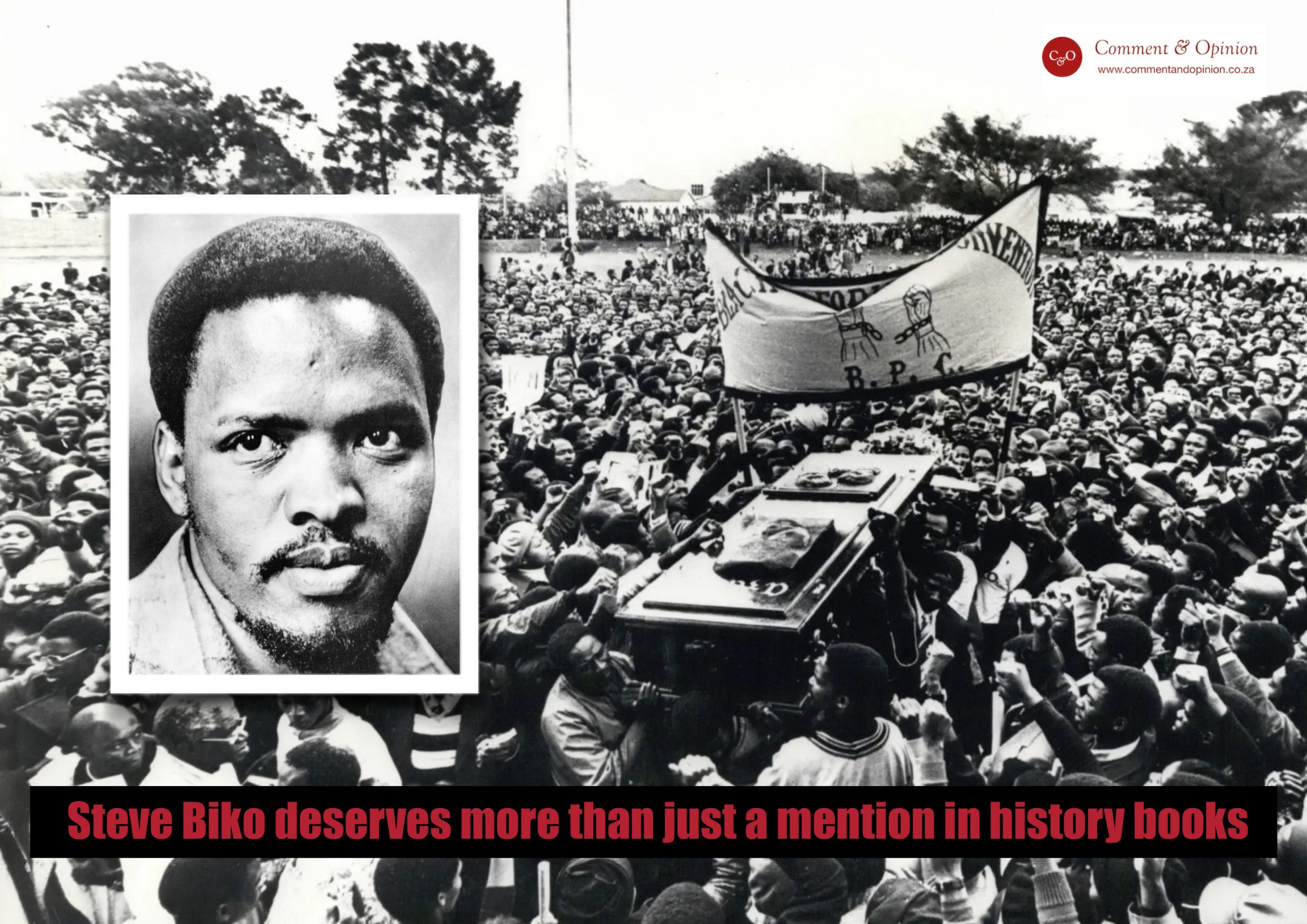
Steve Biko was not just any activist, he was one of the most important leaders of the anti-Apartheid struggle of South Africa, and the whole world was shocked by his murder. His funeral in King William’s Town was attended by 20,000 people, defying the Apartheid police with their bullets and sjamboks, and foreign diplomats from thirteen nations as well as an Anglican delegation headed by Bishop Desmond Tutu were present. It was the first mass political funeral in South Africa, showing the importance of Steve Biko for Black people and their yearning for Black pride and the restoration of dignity.
Can such important history really be forgotten or minimised this easily? And should it be? Definitely not.
Young people must learn about the mistakes and crimes of the past
It is totally understandable that the young people of South Africa, who face battles of their own against a failing educational system, food insecurity, high unemployment, criminality and much more, want to live and make it in the here and now. Every young generation wants this and has the right to. But history is never about the here and now but always foremost about how we got here, it is about the past. And it matters, for history teaches us where we came from, what mistakes, not to mention crimes against humanity, were made in the times before now, so young people understand how hard it was to get to the freedom of today, that nothing is granted and that such mistakes or crimes must never happen again – but could if we don’t pay attention and are not informed.
Immense sacrifices have to be made, to achieve what today seems so normal. It is not normal, not in the least. While so many decades have passed and South Africa is troubled by so many grave things, I nevertheless can’t stop marvelling at where this country has arrived. Walk down the streets of Joburg or any other city for that matter, and you will find freedom of the people, and not sjamboks treating people, because of the colour of their skin, like stray dogs. Only if you’ve witnessed the latter – or learn about it in earnest –, can you understand what has been achieved and how precious it is.
Brave, principled humans like Steve Biko made this possible. And pupils in South African schools need to be taught this in history with the seriousness and respect that is essential to make them understand, how hard it was to get to the ’one man one vote’ that now enables every South African to participate in elections and thus in the shaping of their own country.
If you reduce history to only a collection of puzzle pieces, thrown carelessly into the room without teaching understanding of exceptional human sacrifices, your final picture might dazzle with exuberant variety, yet fail to make you understand what mattered and what moved. And if you shift an important pillar holding up a house to the sidelines, reducing it to be nothing more than one brick in the wall, every architect will tell you that the statics of the building will be compromised and sooner or later the house will come down, because the foundation will have become brittle. South Africa cannot afford this.
Will the day come when Madiba too will be reduced to only two hours in an otherwise generalised history curriculum? How much of this South Africa will survive, if so?
Teaching about courageous resistance and Black pride matters
In Germany, year in and year out to this day, pupils learn at school about the courageous men and women who challenged Hitler and even attempted to assassinate the dictator to free Germany from fascist rule. They did not succeed, but they too helped pave the way – just like Steve Biko – to end a regime that was pure horror. No one in Germany to this day, 81 years after the war, questions how important it is that young students learn in history lessons the biographies of these brave, principled resistance fighters and what they went through and took upon them – and how they were killed. In South Africa, only 32 years have passed since Apartheid was dismantled. And already now, just around the important Freedom Day, it is felt by those in charge of drafting a history curriculum, that teaching seriously and not just in passing the story of Steve Biko and the Black Consciousness Movement is not important enough any more to be taught on its own?
I would bow my head in utter shame to Steve Biko and all those who sacrificed their freedom and even their lives in order to make the South Africa of today possible, if this would go into effect. I can neither forget the woman in the van, robbed of all that is human pride and dignity, nor all the others I witnessed on so many, many occasions being publicly treated like stray dogs. And I cannot forget those that were ’falling’ from windows high up at John Vorster Square, or were shot in their beds, or in the bushes next to a street, having been dragged out of their car in the dark of night. Steve Biko gave his life to end this. The least we must do today is teach about exceptional humans like him with the respect and the historical necessity owed to him and the movement – and subsequently to us and the generations to come. For it can inspire them and fill them with the necessary courage to speak up against human rights violations and crimes against humanity, should they ever arise once more.
Ignorance is not bliss, it is the beginning of the downfall. South Africa must never be allowed to suffer that again.
.
.
Find more information on the draft of the new history curriculum and why it is problematic and should not come into effect:
‘Anti-intellectual and soul-deadening’: Prof Jansen slams proposed history curriculum
Mamphela Ramphele unhappy over downgrading of Steve Biko in matric history syllabus
Let’s tread carefully as we reconsider our history curriculum
SU voices criticise new history curriculum
The date for giving input by the public to the proposed amendments to the Grade 4 to 12 history Curriculum and Assessment Policy Statement (CAPS) has been extended to May 19th.
You can find the proposed amendments on the website of the Department of Basic Education and you can comment on the draft. It is vital to make use of this possibility.
Leave a Reply